– A lot of questions I receive revolve around editing and proofreading, so I decided to make an extensive guide to editing your own writing. I collaborated with some amazing friends on this post so this is dedicated to them as well as all of you. I hope you find it useful. Enjoy!
Know The Difference: Editing vs. Proofreading
Editing is about the content, proofreading is about the technical detail and accuracy. Once you know the difference and you separate the two into different tasks, going through and actually doing it will seem less daunting. Deciding which to tacking first depends on what you’re like when you edit, but if you struggling with focusing on actually improving the content because you get distracted by grammatical errors and spelling mistakes, then proofreading first may be a good idea.
Be Intentional With Your Vocabulary
Avoid adverbs
Be frugal with unique adjectives
Only use dialogue tags when absolutely necessary
Be mindful of overused words
Take the time to find the right words
The words you choose can make all the difference so pay special attention to them.
Just Keep Snipping
A basic rule to editing that people often forget it, if it doesn’t serve a purpose, you should cut it out. A short book that is amazing all the way through is better than a long book that is redundant. Don’t worry about leaving your readers in the dark or not having enough content. As you edit, you’ll find ways and places in which to input more information.
Flow & Rhythm
This is the part where you make sure the writing itself sounds how you want it to. It’s important to read your writing aloud during this stage. Some things to pay attention to regarding flow and rhythm:
sentence length/variation
sentence structure
syllables and how they fit together
how your writing sounds out loud
Eloquence
Say it once and say it clearly. Redundancy bores readers so quickly, so when putting information forward, be clear, concise, and don’t add fluff. You don’t need to write a whole paragraph about how a character feels in a situation. It’s important to give the reader just enough to read between the lines.
Grammar
Common Grammar Mistakes To Look For
Subject-verb agreement errors
Sentence Fragments
Missing Comma After Introductory Element
Misusing The Apostrophe With “Its”
No Comma In A Compound Sentence
Misplaced Or Dangling Modifier
Vague Pronoun Reference
Wrong Word Usage
Run-On Sentence
Superfluous Commas
Lack Of Parallel Structure
Sentence Sprawl
Comma Splice
Colon Mistakes
Split Infinitives
List from here x {Explains these further and more in depth}
Improper Use of Phrases
“could have” not “could of”
“My friends and I” not “me and my friends” {If you take away “my friends” or “I”, or one of the nouns in a sentence in general, the sentence should still make sense}
“I couldn’t care less” not “I could care less”. This should be a no-brainer.
etc.. I could go on.
Familiarize yourself with these common mistakes and avoid making them at all costs. It’s also helpful to have someone read over it and let you know when they find issues with phrases you used. Please be attentive to these mistakes because making them can destroy your credibility as a writer.
Utilize The Senses
If you’re describing something in your writing, you should be slipping in words and little details that appeal to the reader’s senses, When editing, look for opportunities to slip in how a place smells, how a food tastes, how something feels to the touch, etc. It’s unbelievable how much this enhances your story.
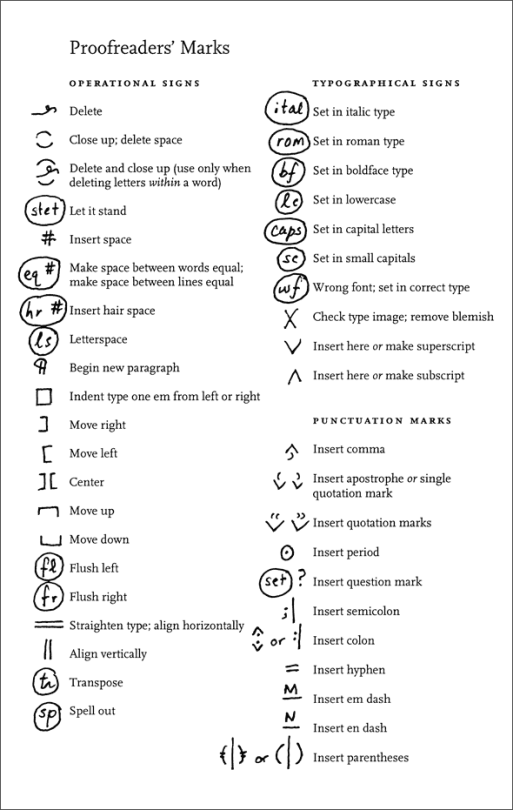
When proofreading and marking up your manuscript, it can save a lot of time and energy if you use marks instead of actually write out everything, so here is a little chart I found that may be useful to you:
Other Things To Look Out For
Make sure you know who is talking
Keep tense consistent
Vary the tone from scene to scene
Run-on sentences
Inconsistencies in story details
Plot holes
Causes and effects of events are explained
Facts and technical details {Make sure you’ve researched them well}
Deviations from established background (know your story really really well and make sure your reader does too)
General Tips
Go in assuming that your work is full of errors. Maybe it’s not, but it’s better to be prepared for the worst and solve the issues now rather than when it’s too late
DO NOT BE SENTIMENTAL. Yes, easier said than done, but it’s possible.
Make the text less recognizable to yourself in order to catch details you may not otherwise.
Print out your manuscript and physically write out the changes.
Read your writing out loud. Sometimes writing looks like it makes sense, but in reality sounds wrong.
Do it in short periods over time so that you don’t inevitably get lazy with paying attention to little details
Keep in mind that editing usually takes longer than actually writing the draft because it is less fluid and requires more thought and problem solving.
Don’t rely on spelling and/or grammar checking software; they’re not always correct and can easily misinterpret what you’re trying to get across.
Check for a single error at a time. It may be time consuming and tedious but it’s more effective than the alternative.
Give yourself time and read slowly through it multiple times
Split up large chunks of text to make it easier to handle. Don’t go through your whole manuscript page by page as if you were just reading it as a book. Go chapter by chapter or scene by scene or even sentence by sentence.
If something seems off, investigate it. Don’t take a chance and leave it be. If you’re stumped, highlight it and have someone else look over it.
Have a strategy. Maybe not at first, especially if you don’t extensively edit your work regularly, but with time you’ll find what works for you and what doesn’t. Create your own system and use it to save yourself some time and confusion.
If you’d never drawn a person before or thought you didn’t have much time, you might do one of these guys:
Example A: stick dude. A stick dude is recognizable as a person because it follows the baseline, easiest rules of personhood. It’s got a head, a torso, a familiar arrangement of limbs. You don’t need more to get the concept of “person” across.
Now, if you had a bit of experience drawing people or thought you had more time, you might do something more like
Example B: Cartoon Dude. Cartoon Dude is even easier to recognize as a human. He follows the rules of personhood even more: he’s got facial features, ears, hair, clothing, shoes. You can tell one cartoon dude from another cartoon dude. You can populate an entire series with cartoon dudes and the storytelling would work, because they would effectively follow the baseline rules of human anatomy as well as being unique enough to tell apart.
Now let’s say you had a bit more time or you had some more experience drawing people and someone asked you to draw a human realistically. Depending on how much you’d done it, you might get
Example C: 3-D dude without reference. A 3-D dude drawn without reference is even more recognizable as human. He can hold all sorts of nuance in his expression because he follows the baseline rules of personhood even better than the previous two. More nuance means more empathy from the viewer, and more empathy usually means more emotional resonance.
And finally, let’s say someone asks you to draw a human but gives you an actual person to look at. In the same amount of time given, you might end up with
Example D: Portrait with reference. This guy (one of my brothers, in fact) follows the rules of personhood, their effectiveness limited only by my ability to capture them in the time given or by my level of experience. He’s recognizable as both a person and an individual because of the specificity of his facial features, and moreover, he is unlikely to look like any other person I would draw using this method because of my close adherence to his, you know, actual face.
If you think about this in terms of characters, you could build a novel with any one of these sorts of character.
Example A: A novel built with stick man characters would be incredibly stylized. Fairy tales are often stick figure characters. Instead of being fully-fleshed individuals, they’re types. This is the stick figure woodsman (we can tell it’s him, he’s drawn with an ax). This is the princess (we can tell it’s her, she’s got a crown and some long hair added to the stick figure). This is the knight (we can tell it’s him, he’s got a sword and a stick horse). People don’t actually look like stick figures, but as long as the characters are all stick figures, the narrative still works at some level, because it tells you the rules and follows them, even if they aren’t the rules of reality. The moment you draw one character as something more than a stick figure, though, the viewer suddenly realizes how the others are merely made of straight lines.
Example B: When I first began to write, I used to write novels with accidental cartoon characters. I knew I couldn’t populate a novel with stick figures, so I tried to flesh them out. What makes a human a human? I asked myself desperately. Specifics! I made character worksheets and dutifully filled them out with attributes. Height, hair color, eye color, hobbies, place of residence, parental occupation, etc. etc. I ended up with characters who followed the rules of being human, and they could carry a story, but they still didn’t feel real.
I’m skipping Example C for now, because it’s a byproduct, for me, of failing to remember the lessons of Example D.
Example D: Example D is how I build characters now. I begin by studying real people instead of by creating lists of traits. I end up with shadows I forgot to draw in my cartoon version, hair that looks like actual hair instead of what I sort of remember what hair looks like, and feet that have all the toes drawn in because with a reference, I can remember how to accurately draw a pinkie toe. Real people are complicated and surprising. If I were building a character with a fear of water without looking at a real person, I might give them the phobia because they’d nearly drowned once: the easiest and most logical answer. It wouldn’t necessarily be wrong — it would follow rules that a reader would understand. But if I looked at a real person with a fear of water, I might discover that their fear developed because of an obsession with quantifying the abstract, and trying to understand the concept of an infinite body of water made them anxious. A much more complicated answer, but more specific and more real because of it. If I populate a book with characters built like this, I’m going to end up with a nuanced story that should have more emotional resonance. Moreover, the more I study real humans and build characters from them, the less I have to lean on real humans to make secondary characters. As I learn the more subtle rules of how people’s personalities are made, I can start to build new humans who don’t exist — who nonetheless appear as if they could.
Example C: I’m returning to example C because it’s a cautionary tale for me. Even though I feel that I’m worlds better than that old version of me writing cartoony people who could only exist in a two-dimensional place, if I get lazy with my character development, or if I try to create a sort of person I’ve never met in real life from scratch, I can still end up with one of these weird cartoon-realistic hybrids. A character who nearly looks real but lacks the subtle, observed nuances that I can only get from keeping an eye on real life. These characters follow the rules, and they have back stories and hobbies and nuance, but they’re still lacking the surprising, non-linear subtleties of a real person, or they’re lacking the specificity that comes from studying a real-life elbow and carefully transcribing the shape of it.
There are particular sorts of things I look for in real people when I’m stealing bits and bobs, but that is a topic for another blog post. For now, I’m going to go figure out why I still can’t draw feet.
At the start of the story she’s only a few weeks along, and it’ll follow her at least until the baby’s birth. What issues might affect her as a pregnant autistic woman?
Some people love being pregnant, they feel really healthy and love their bodies. Other people really struggle, feeling unwell and in pain.
Pregnancy will come with changes to your character’s body. This includes changes in hormones which can lead to fluctuations in her emotions and sensory needs. She will also have physical changes (abdomen gets bigger) which can cause pain and issues with proprioception.
She might experience nausea/morning sickness. Any pre-existing hypersensitivites, combined with hormonal changes to her sense of smell and taste, might her extra susceptible to nausea.
Pregnancy can lead to tiredness, aches, and pains. If this is the case, it may impact her ability to cope with difficult social situations, and may lower her threshold for withstanding difficult sensory environments.
Of course, some people feel really healthy when they are pregnant, so she might really enjoy herself! Part of it seems to be down to luck.
Pregnancy comes with lots of things to organise. Less than once the baby arrives, but there are still many medical appointments to attend, arrangements to be made for the baby’s arrival, and changes to diets to manage.
Of course, your character is likely to have co-occurring physical or mental issues which might be complicate by pregnancy. For example, if she already experiences anxiety and cognitive distortions, common worries about her child’s health are likely to present more of a problem than in a neurotypical mother.
Pregnancy also means that she might have to adjust any medications she is on. If the character takes anti-epileptics to manage seizures and mood-stabilisers to manage hypomania, then she will be affected by changes to her meds as well as by hormonal changes. She might need to have more frequent check-ups with her doctor to make sure that she stays healthy during these changes.
If she was previously a drinker/smoker then pregnancy might give her the impetus to give up, but changes to non-prescription drugs can also have an impact.
Your character may find pleasure from doing research related to the pregnancy. There is lots to read about, and she might enjoy planning the birth, researching how foetuses develop, or looking into the origins of various names. In this post a mother talks about using routines and schedules
to help manage changes to her body and hormones.
As her pregnancy progresses, your character may find that others begin to treat her differently. This might be differences in people’s expectations for how she behaves as they try to accommodate the changes she is experiencing. On the other hand, there may also be times when she has to tell other characters that she needs accommodations like changes to dress code or seating with more back support.
She might also find that she has to adapt the social scripts that she uses because people might start asking new questions like “when are you due?” or making jokes about her belly.
I don’t think that it is relevant to your story, but as this post will be shared with other writers I feel that it would be remiss not to mention the discrimination that disabled parents face, which I talked about in more detail in this post about obstacles for an autistic parent raising a baby (eugenics cw).
It is worth looking for autistic people’s accounts of their pregnancies. Here are a few examples:
[edited to add a link missing in the original post – thank you to @scriptaccountant for pointing out the mistake!]
Imho a great approach to this would be to figure out your character minus the pregnancy and then ask yourself ‘what would be that character’s logical reaction to the changes pregnancy creates?’
For example, if you have an autistic character who loves research and scheduling, certain aspects of pregnancy would be quite enjoyable: scheduling checkups, researching fetal growth, researching diet tips, scheduling pre- and post-natal activities such as yoga or parenting classes, etc. However, other aspects may be troublesome; babies rarely come right on their due date, for example, which would cause someone who adheres to a strict schedule a great deal of stress.
Not all autistic people experience things the same way. Another example: doctors offices and hospitals can be very stressful for many of us (fluorescent lights, monotone colors especially whites, lots of people, loud announcements, lots of activity, tons of official forms to fill out, things rarely happen on schedule) but for some they are almost comforting (sterility, order, clear instructions/expectations from staff, etc.).
Neurotypical people have wildly carrying experiences of pregnancy based on their personalities (an extroverted person would find attending parenting classes enjoyable but an introverted person may find them difficult).
Neurodivergent people will be the same. That is why it is important to establish your characterization beforehand—even if you never show them when they are not experiencing pregnancy—so that your characterization will feel detailed, well-planned, and authentic.
So, as we all know, there are many different kinds of magic — and more being discovered every day as writers create them. It’s true that every world as different and therefore each type of magic created will be different, but following a few of these tips can help you flesh it out just a bit more.
1. Consider your world’s history. Were there ever any major events involving magic or knowledge of it? How has magic proven useful in the past? How much has your culture changed since that time; are its past uses still applicable? Has there been a history of more powerful people having a possession or knowledge of magic?
2. Decide how magic is seen through the eyes of the people. Is it taboo? Dangerous? Helpful? Is it a practice that has to be kept in secret or can it be done anywhere? Are there certain places for it? Consider the people with more knowledge of it: are they seen as wise or dangerous? Are there people with professions dedicated to it?
3. Determine its use in everyday life. Is it used to help complete regular tasks? What about in education? If your world has an education system, what is magic’s importance within it? Are there everyday items that posses magic? Are these items considered benevolent or evil? Can items be enchanted to help around the house, or is magic reserved only for things of major importance?
4. Think about the people using it. Is there a general age range for people using it? If the range is broad, are there common uses for each age group? More than age, is there a general social status of people with access to it? Is there a stereotype that follows these people? Or a wealth level? Or even an appearance?
So, those are all the magic tips I’ve got for you today. If you’d like to see me cover a topic, be sure to drop a message in my ask box; see you next time with another writing post!
All autistic people are different. Your character’s reaction will depend on their personality, their attitudes towards romance, whether they are interested in the person who is flirting with them, etc.
Depending on their social skills and amount of experience with these sorts of situations, they may also not realise that the person is flirting with them, or they may be slow to recognise the flirting.
An autistic person is more likely to feel uncomfortable with flirting than an allistic person because it is an unfamiliar social situation where they might have not had a chance to learn any social scripts or what types of responses are considered appropriate.
These are all generalisations; there is a lot of variety in how autistic people respond to flirting. Your character might enjoy it, they might hate it; you will need to think about how your character’s attitudes and specific situation shape his reaction.
You want to write an au in which Will and Hannibal run off and speak to each other in a ton of languages? We got you covered. Here’s a list of people that offered to translate sentences in their first language.
( i hope someone else offers too so we can double check )
Latin and Ancient Greek. And my hieratic is ok… for those ancient Egypt AUs. Ok now I’m tempted to write a stargate crossover with hieroglyphs..
Lol @electrarhodes A Hannibal/Stargate crossover would be something else.
Slightly redundant after @electrarhodes‘ offer, but my ancient Egyptian is ok. I’m probably better at Old and Middle Egyptian, though, rather than Late Egyptian.
Hmmm, now I’m wondering if there’s a way to mash up Egyptian mythology and Hannibal. After all, there is the Egyptian text known as “the cannibal hymn”.
(This post is an excerpt from Maim Your Characters: How Injuries Work in Fiction.)
First off, let me be clear about what I mean when I say the
word scars. I’m not talking about the
medical definition: rough tissue that overlies a wound as it heals over time.
I’m using a broader definition of any physical evidence of a previous injury.
That can be the amputated hand, the limp from a spinal cord
injury.
It can also include tattoos. (Maui’s moving tattoos in Moana are a perfect example of this: his
tattoos are a physical embodiment of where he’s been.)
Scars, by this broad definition, are an interesting
shorthand for a story, whether we actually see that tale or not. We use them as
a way to say there’s a story here.
Sometimes our global story gives us the chance to tell it, sometimes not; either
way, scars can be an interesting way to add depth to a character.
In fact, sometimes a scar is integral to explaining and
understanding who that character is.
For example, we know that Peter Pan’s Captain Hook has been involved in some fierce battles,
because he lost his hand – and had it replaced with his legendary pirate hook.
That hook is a symbol of the cold cruelty he now gives off.
The eponymous Harry Potter wouldn’t truly be Harry without
his lightning-bolt forehead scar. For Harry, it’s not just about his past, it’s
about his future: his fate and the fate of the scar-giver are intertwined, a
battle that will determine the fate of the world. Worse, it’s all inscribed on
his forehead, for everyone to see.
Darth Vader’s scars in Star
Wars are extensive, so much so that they shroud his identity completely.
While we see the faces of the heroes, and even of Emperor Palpatine himself,
Vader’s wounds require a respirator mask that obscures his face and makes him
the terrifying villain he is. He’s actually turned the support system he needs
to stay alive – a depersonalizing suit and respirator – into something useful,
a mask to terrify his enemies. Vader’s life is, in some ways, enhanced by his disability, and he’s
certainly comfortable moving in his world with the scars he’s got.
In Moana, the
demigod Maui’s scars are branded on him as tattoos. These are the stories of
who he’s been and where he goes. When hero-protagonist Moana asks him where
they come from, he tells her, “They show up when I earn them.”
This isn’t dissimilar to the battle scars on an old soldier,
sailor, or mercenary: their wounds are manifested on their flesh.
But if scars are
shorthand for a story, if they’re someone’s past writ large, we need to honor
that character in the way we represent them. If we elect to give a character
scars, they should represent not a plot
but a story, something that not only
wounds the character but drives them to change internally.
As an example, I’m going to tell you the story of two of my
personal scars. At the end we’ll discuss which one would go into a story about
me, and why.
Scar #1: The Knife Point.
When I was six or seven, I was trying to get some corn off the cob — I wanted
to eat it in kernel form for some reason, and I was using a kitchen knife. I
got the corn off all right — and drove the point of the knife straight into the
webbing between my thumb and forefinger on my left hand. Ouch!
(Actually, it didn’t hurt, it was the sheer volume of blood
that was terrifying).
I changed in that I learned not to do that specific task
(cutting corn off the cob) that specific way (driving the knife toward my
hand).
But it’s not a marker of who I am.
Scar #2: The Bite
Mark. Let’s consider another scar, also on my left hand. There’s an old
bite mark by the heel of my hand, at the base of my left thumb.
It happened like this: I was fifteen or so, and my
neighbor’s dog, Clancy, wasn’t doing well. He was old and he was sick. That day
he had become too sick to get up. It was time for my neighbor to take him to
the vet and say goodbye.
She had him on a blanket. But he was a big dog, and the vet
was far, and she didn’t have a car, and so our neighbor came to ask me and my
mom to help get him to the vet. Of course we said yes. We liked her, but more
importantly, we loved animals. (Both my mother and I had worked at the vet at
one point or another.)
When we went to move him by picking up the blanket and
moving him to the car, Clancy reached out and bit me. Not because he was a bad
dog, not because he was out to hurt me. He bit me because he was scared and
sick and hurt and he didn’t know what to do.
I didn’t feel anger at Clancy, and I didn’t turn afraid of
him. I felt sympathy. His act hurt my
skin. His pain broke my heart.
So when we got him to the vet, while they were easing his
pain and saying goodbye, I calmly and quietly washed my wound in the sink with
an antiseptic.
I learned something about myself in that moment.
I learned that healing really is a calling for me. That I
was glad we had cared for him and that I was able to help him on his final
journey. I was glad to know Clancy. I wasn’t mad, or hurt, even though my hand
stung from the antiseptic.
That scar helped me find my internal true north.
Now, which of those scars has meaning? Which of them would
you want to include if you were writing me as a character? Which do you think
would make it into a memoir, if I wrote one? It’s most certainly the second,
the one that helped me figure out who I am, the one that drove me to learn about
myself. The first is something that happened; the second is something that
changed me.
It’s stories like these that you should use in order to
figure out who your characters are – and how to honor them.
Let’s Talk Tattoos.
Tattoos are interesting in that they can be another, more interesting set of shorthand. Unless your
character has a Maui-like situation going on, her tattoos won’t simply appear.
She’ll not only have to choose what
story she wants to represent on her flesh, but she’ll have to choose how to
express that story in an image. Then comes the pain of the ritual
scarification: the injection of ink under the skin, a microbaptism in pain and
blood and pigment.
Tattoos are absolutely fascinating.
Because they don’t typically connect to physical wounds so much as to emotional
ones, they’re a really great piece of shorthand for getting into the depths of
who someone truly is.
My own tattoos are direct messages to myself about how I
should live in the world. They’re an easily visible piece of guidance that
explores what my role is and should be in the world.
Of course, not all tattoos have this deeper meaning. People
choose to tattoo things on themselves for a hundred different reasons, the
aesthetics of the design being one of them. Some tattoos are simply trendy. I’m
not here to judge anyone’s ink!
But if you’re going to cover a character in tattoos,
consider having each of them explore a deeper facet of that character’s
personality and the journey they’ve been on.
How to Use Scars
Effectively
As we said above, scars are a shorthand for a story.
Prominent scars, particular facial or obvious hand scars, are a constant source
of tension and questions. When someone has a big scar on their face, we find
our eyes drawn to it, a question forming on our tongue: What happened?
But the What happened?
isn’t as important as How did it change
you? And so my general recommendation with scars is twofold and
contradictory:
One: only
introduce scars if it’s an incredibly important part of a character’s past.
Two: only
introduce scars if it’s an incredibly important part of a character’s future.
So why the two recommendations? Why the contradiction?
Characters are constantly moving, if not in space, then
through time. Their scars shape their past, which shapes where they are now and
where they’re going.
If a scar is germane to a character’s past, it helps establish where they’re coming from and what their
experiences have been.
But those experiences are only important if that
scar-causing event is relevant to their future.
The scar a sea captain got fending off pirates once upon a
time doesn’t have much to add if his current quest is finding new plumbing for
his house. His scar isn’t relevant, unless it intimidates the shady plumber
into giving him a better price. Even then, it’s a shallow connection.
Consider the old injury (and its scar) to be a cause.
Ask: what was the effect?
If your character got a scar on their eyebrow from a bike accident when she was
seven, that scar doesn’t mean anything… unless that was the bike accident where
she failed to protect and save her kid brother, which makes her overprotective
and hypercautious now.
If she crashed her bike as a kid and merely went on with her
life… what was the point? Why tell that story with a scar so visible?
Remember that the point of a story is that people change. If a scar doesn’t
fundamentally shape a character, consider simply leaving it out. Window
dressing is just that: window dressing.
What we want is to give more insight into who your character is.
Avoiding Wandering
Scar Syndrome
Wandering Scar Syndrome is when a character’s scar is on
their left eye on Page 3 and their right cheek on Page 12. It’s simply a
symptom of not taking good notes.
There are two techniques I’m going to suggest here.
The first is, keep character sheets. Many writers choose to
do this, many do not. But especially if you’re going to wallpaper your
character with scars and tattoos, it’s worth writing down where they are and
what they look like. In fact, copy/pasting the way they were originally
described into a separate document is particularly helpful in being sure your
descriptions stay consistent throughout the story. It’s a pain in the butt for
a moment, but it helps so much with
consistency down the line!
Another option is to use [brackets] as an aside.
What do I mean?
Let’s say you talk about a minor character in two different
places in the story, chapters — even acts apart.
Kitty Scarborough was
the best fighter in town, and she bore the scars to prove it. [Kitty Scar
Description — line on her face?] Or, [scar TK]
TK is the
editor’s mark for To Come, a placeholder of sorts, and it’s useful for all
kinds of things: Name TK, Dog Breed TK, Red sports car [make/model TK], etc. (Once
upon a time, this book was littered with TKs .)
Later, we can pull it back up: A tall redhead walked through the door. Kitty Scarborough was easy to
recognize, especially by her [Kitty Scar Description].
Why does this work? Why is this helpful?
Because it allows us to maintain flow as a writer. If we
know Kitty’s got scars from fighting, we can come up with what exactly those
look like later. (We’re using them as evidence of her toughness and battle
prowess, not for a particular meaning behind each individual scar she’s got.)
So when we describe Kitty, we don’t need to spend ten minutes racking our brain
for a cool scar to give her — we can do that later. All we need to drop into
our first draft is [Kitty scar] and we can move on!
This works for all sorts of details, from car models to hair
colors to background characters’ names, so don’t think it’s just a scar
locater!
Later on we can come back, look through our manuscript with
the magical Find tool, and simply search for that left bracket, [ . Anything
that comes up can be filled in with your text!
Want a good scar
generator, including ideas for how it
shaped the character?Visit MaimYourCharacters.com/Scars
!
This post is an excerpt from Maim Your Characters, from Even Keel Press. If you’d like to read a 100-page sample of the book, [click here]. If you’d like to order a print copy, it’s available [via Amazon.com], and digital copies are available from [a slew of retailers].


 Mostly reblogs and random words