catch of breath, choke, gulp, heave, inhale, pant, puff, snort, wheeze, huff, rasp, sharp intake of air, short of breath, struggle for breath, swallow, winded
(Just a tool that might help clean up your writing and create a faster paced reading experience.)
Removing excess words. If you don’t need particular words, why keep them?
Another crashing wave sends me into a sprawl, and I’m forced to use my tides a few more times to distance myself from the rocks.
I should drop down as deep[er] as I can manage [and] use the reef for cover.
I can’t tear my eyes away until he disappears fully from view.
A burst of lightning shows the outline[s] of the cliff side.
A loud thud from the port window makes me jump, drawing my full attention. -> I jump at a loud thud from the port window.
Showing instead of telling. Making the reader feel what the protagonist feels is almost always better than telling them the protagonist is undergoing something.
I can’t believe the sight I see. -> My lungs catch painfully, a shocked squeak rising out.
Everything is slick and wet. -> The slick metal offers no hold for my wet hands. I clench my fingers until the ridges bite into my scales, shark teeth holding me in place. Agonizing.
Removing passive voice. Active voice is more engaging and should be always be used unless you have a specific reason not to use it for that sentence.
The rock is a muddled, dark brown, and I almost miss him amid the lofty coastline. -> I almost miss him against the muddled, dark brown rock, his body tiny amid the lofty coastline.
Her voice is strained and furious. -> Fury strains her voice.
The wound is closed again, but before it closed, enough blood seeped out that I now feel woozy and off kilter. -> The wound closed while I slept, but enough blood seeped out that my head still spin, my limbs heavy.
Always remember though: you have to do what works best for that particular moment. Some scenes require different strokes than others. Use your best judgement, and take pride in your personal writing style.
Does your story feel too rushed? One easy way to control pacing, add suspense, and cue the reader about big changes in your story is to have your main character pause at major thresholds.
Thresholds are literal or figurative doorways that a protagonist walks through at key moments of the story. They represent moments of change: On one side of the “door” the rules are totally different than on the other side. Think Harry Potter going into the Chamber of Secrets, or Katniss Everdeen getting thrown into the Hunger Games. Once those characters “crossed the line,” they couldn’t go back.
In both of those examples, you might have noticed that Collins and Rowling slowed the story down a beat. Katniss had a 60-second delay where she sized up her situation. Harry had to solve a series of puzzles to get to the door. And for good reason: They’d been moving toward that big change for pages and pages, so it would be weird to rush straight across the threshold without a moment’s pause.
So if your story feels like it’s moving at a break-neck speed, look for thresholds or turning points where you can slow down. Show us details. Add another obstacle between your character and their goal. Let us hear their thoughts, hopes, and hesitations as they move into the next phase of their story. Show us why this moment is important. We won’t get impatient–in fact, if you’ve prepared us well enough for the moment, taking a pause will only increase the suspense!
My ability to proofread increases by 1000% after I hit “Submit”.
this is often because when you’ve submitted something (like fanfiction to ao3) it will be in a different font, size and framing than in your word processor. The text will look different in the new environment so your brain stops skipping what looks familiar (like a typo that has been there since the beginning).
So, tip: revise your work in a different font and size. I guarantee you’ll catch more typos and mistakes than otherwise.
For all my writers (ones I follow and the ones that thankfully follow me)
– One of the most requested subjects for an article is writing horror, so I decided to make this week predominantly about that. I’m also posting a “Resources For Horror Writers” in the next couple days so keep an eye out for that. For all of you horror writers our there who requested this, here you go. If you’re interested in the genre and are looking to give it a shot, this might also be useful to you. These are some pretty universal, basis tips, but should either be a helpful start or a helpful reminder. Either way, I hope you enjoy.
Ground The Main Conflict In Reality
Some of the scariest stories out there are completely possible. You don’t need a scary demon alien monster to scare people. A really cool thing about horror is that it leaves the reader feeling paranoid and you, as the author, get to decide about what. Your reader’s stream of consciousness should be as follows (or similar):
“Oh my gosh, the protagonist was brutally murdered in a house. I have a house. And they were beaten to death by their uncle. I have an uncle. And he owns a hard object. Oh my gosh. What if I get beaten to death by my uncle in my house. At night. Oh god. No sleep for me, I guess.”
That’s the goal.
Be Intentional With Your Characters
You need to know your characters really well in order to infer how they would react in certain situations, especially ones that are full of pressure and strenuous, emotional weight. For this, it might be useful to evaluate their past that you’ve created. Think about how they would react in less pressure-filled but similar situations, pick out a few key details about how they made decisions and turn up those aspects in the main event. Your character’s actions should be true to their personalities and your readers’ reactions shouldn’t be “Really? That doesn’t seem like him.”
Sort Out The Tone
So you know that you want to make your book scary and suspenseful. Now you need to learn how to do that. Common things that increase suspense: ditching the predictable outcome, making it seem out of the blue, etc. Things that set the tone for a scary scene: darkness, fog, silence or ominous sounds, etc. Figure out what you want the tone to be and find ways to convey it.
Frustrate The Reader
Part of the beauty of horror is that, in 99% of situations, the conflict, or at least the major tragedies were completely avoidable and the red flags that signaled danger were right in front of the protagonist’s face. The girl who picks up her phone and hears “I’m outside with a knife and I know you’re alone” doesn’t immediately lock herself in a safe place and calls the police. Instead, she gets the bright idea to venture out of her home and try to find the person who is pretty damn confident they could kill her and get away with it without a problem. The frustration the reader feels due to this incredible lack of common sense is really quite special when it comes to horror, because feeling frustration is a very nice segway to feeling fear.
Recognize What Horror Is
Horror is, essentially, just like any other story. There are characters, a conflict, twists, turns, and elements that make us care when the protagonist is struggling. In horror, the art to it comes with taking the plot twists and making them more intense, upping the tragedy when our beloved characters struggle, and turning the fear of the whole ordeal into the main attraction. In horror, you’re taking the underlying anxiety of normal fiction and throwing it in the reader’s face.
Get To Know Your Psychology
Part of the beauty of horror, or any writing really, is that with a little bit of research you can learn ways to trigger emotions and parts of the brain the human reading your story doesn’t even know exist. Humans are programmed to be afraid of the dark. Use that. People are commonly afraid of things like heights and spiders because their ancestors were harmed by them. Use this basic psychological knowledge to manipulate your readers’ emotions.
– A lot of questions I receive revolve around editing and proofreading, so I decided to make an extensive guide to editing your own writing. I collaborated with some amazing friends on this post so this is dedicated to them as well as all of you. I hope you find it useful. Enjoy!
Know The Difference: Editing vs. Proofreading
Editing is about the content, proofreading is about the technical detail and accuracy. Once you know the difference and you separate the two into different tasks, going through and actually doing it will seem less daunting. Deciding which to tacking first depends on what you’re like when you edit, but if you struggling with focusing on actually improving the content because you get distracted by grammatical errors and spelling mistakes, then proofreading first may be a good idea.
Be Intentional With Your Vocabulary
Avoid adverbs
Be frugal with unique adjectives
Only use dialogue tags when absolutely necessary
Be mindful of overused words
Take the time to find the right words
The words you choose can make all the difference so pay special attention to them.
Just Keep Snipping
A basic rule to editing that people often forget it, if it doesn’t serve a purpose, you should cut it out. A short book that is amazing all the way through is better than a long book that is redundant. Don’t worry about leaving your readers in the dark or not having enough content. As you edit, you’ll find ways and places in which to input more information.
Flow & Rhythm
This is the part where you make sure the writing itself sounds how you want it to. It’s important to read your writing aloud during this stage. Some things to pay attention to regarding flow and rhythm:
sentence length/variation
sentence structure
syllables and how they fit together
how your writing sounds out loud
Eloquence
Say it once and say it clearly. Redundancy bores readers so quickly, so when putting information forward, be clear, concise, and don’t add fluff. You don’t need to write a whole paragraph about how a character feels in a situation. It’s important to give the reader just enough to read between the lines.
Grammar
Common Grammar Mistakes To Look For
Subject-verb agreement errors
Sentence Fragments
Missing Comma After Introductory Element
Misusing The Apostrophe With “Its”
No Comma In A Compound Sentence
Misplaced Or Dangling Modifier
Vague Pronoun Reference
Wrong Word Usage
Run-On Sentence
Superfluous Commas
Lack Of Parallel Structure
Sentence Sprawl
Comma Splice
Colon Mistakes
Split Infinitives
List from here x {Explains these further and more in depth}
Improper Use of Phrases
“could have” not “could of”
“My friends and I” not “me and my friends” {If you take away “my friends” or “I”, or one of the nouns in a sentence in general, the sentence should still make sense}
“I couldn’t care less” not “I could care less”. This should be a no-brainer.
etc.. I could go on.
Familiarize yourself with these common mistakes and avoid making them at all costs. It’s also helpful to have someone read over it and let you know when they find issues with phrases you used. Please be attentive to these mistakes because making them can destroy your credibility as a writer.
Utilize The Senses
If you’re describing something in your writing, you should be slipping in words and little details that appeal to the reader’s senses, When editing, look for opportunities to slip in how a place smells, how a food tastes, how something feels to the touch, etc. It’s unbelievable how much this enhances your story.
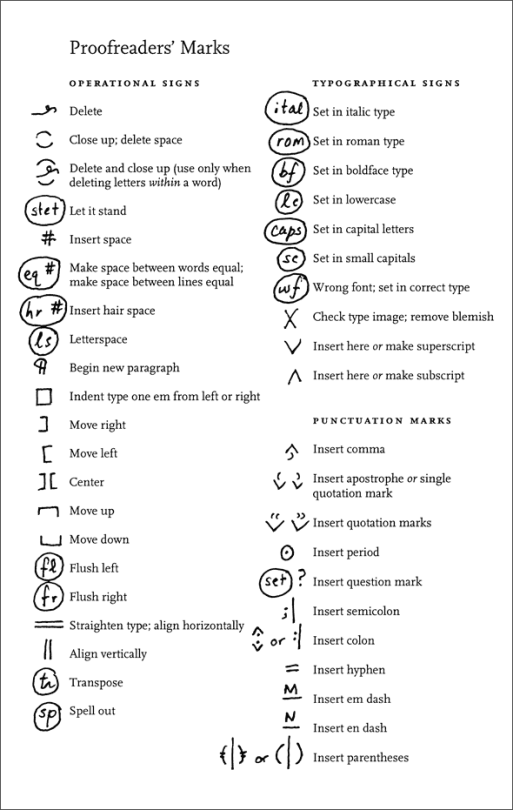
When proofreading and marking up your manuscript, it can save a lot of time and energy if you use marks instead of actually write out everything, so here is a little chart I found that may be useful to you:
Other Things To Look Out For
Make sure you know who is talking
Keep tense consistent
Vary the tone from scene to scene
Run-on sentences
Inconsistencies in story details
Plot holes
Causes and effects of events are explained
Facts and technical details {Make sure you’ve researched them well}
Deviations from established background (know your story really really well and make sure your reader does too)
General Tips
Go in assuming that your work is full of errors. Maybe it’s not, but it’s better to be prepared for the worst and solve the issues now rather than when it’s too late
DO NOT BE SENTIMENTAL. Yes, easier said than done, but it’s possible.
Make the text less recognizable to yourself in order to catch details you may not otherwise.
Print out your manuscript and physically write out the changes.
Read your writing out loud. Sometimes writing looks like it makes sense, but in reality sounds wrong.
Do it in short periods over time so that you don’t inevitably get lazy with paying attention to little details
Keep in mind that editing usually takes longer than actually writing the draft because it is less fluid and requires more thought and problem solving.
Don’t rely on spelling and/or grammar checking software; they’re not always correct and can easily misinterpret what you’re trying to get across.
Check for a single error at a time. It may be time consuming and tedious but it’s more effective than the alternative.
Give yourself time and read slowly through it multiple times
Split up large chunks of text to make it easier to handle. Don’t go through your whole manuscript page by page as if you were just reading it as a book. Go chapter by chapter or scene by scene or even sentence by sentence.
If something seems off, investigate it. Don’t take a chance and leave it be. If you’re stumped, highlight it and have someone else look over it.
Have a strategy. Maybe not at first, especially if you don’t extensively edit your work regularly, but with time you’ll find what works for you and what doesn’t. Create your own system and use it to save yourself some time and confusion.
If you’d never drawn a person before or thought you didn’t have much time, you might do one of these guys:
Example A: stick dude. A stick dude is recognizable as a person because it follows the baseline, easiest rules of personhood. It’s got a head, a torso, a familiar arrangement of limbs. You don’t need more to get the concept of “person” across.
Now, if you had a bit of experience drawing people or thought you had more time, you might do something more like
Example B: Cartoon Dude. Cartoon Dude is even easier to recognize as a human. He follows the rules of personhood even more: he’s got facial features, ears, hair, clothing, shoes. You can tell one cartoon dude from another cartoon dude. You can populate an entire series with cartoon dudes and the storytelling would work, because they would effectively follow the baseline rules of human anatomy as well as being unique enough to tell apart.
Now let’s say you had a bit more time or you had some more experience drawing people and someone asked you to draw a human realistically. Depending on how much you’d done it, you might get
Example C: 3-D dude without reference. A 3-D dude drawn without reference is even more recognizable as human. He can hold all sorts of nuance in his expression because he follows the baseline rules of personhood even better than the previous two. More nuance means more empathy from the viewer, and more empathy usually means more emotional resonance.
And finally, let’s say someone asks you to draw a human but gives you an actual person to look at. In the same amount of time given, you might end up with
Example D: Portrait with reference. This guy (one of my brothers, in fact) follows the rules of personhood, their effectiveness limited only by my ability to capture them in the time given or by my level of experience. He’s recognizable as both a person and an individual because of the specificity of his facial features, and moreover, he is unlikely to look like any other person I would draw using this method because of my close adherence to his, you know, actual face.
If you think about this in terms of characters, you could build a novel with any one of these sorts of character.
Example A: A novel built with stick man characters would be incredibly stylized. Fairy tales are often stick figure characters. Instead of being fully-fleshed individuals, they’re types. This is the stick figure woodsman (we can tell it’s him, he’s drawn with an ax). This is the princess (we can tell it’s her, she’s got a crown and some long hair added to the stick figure). This is the knight (we can tell it’s him, he’s got a sword and a stick horse). People don’t actually look like stick figures, but as long as the characters are all stick figures, the narrative still works at some level, because it tells you the rules and follows them, even if they aren’t the rules of reality. The moment you draw one character as something more than a stick figure, though, the viewer suddenly realizes how the others are merely made of straight lines.
Example B: When I first began to write, I used to write novels with accidental cartoon characters. I knew I couldn’t populate a novel with stick figures, so I tried to flesh them out. What makes a human a human? I asked myself desperately. Specifics! I made character worksheets and dutifully filled them out with attributes. Height, hair color, eye color, hobbies, place of residence, parental occupation, etc. etc. I ended up with characters who followed the rules of being human, and they could carry a story, but they still didn’t feel real.
I’m skipping Example C for now, because it’s a byproduct, for me, of failing to remember the lessons of Example D.
Example D: Example D is how I build characters now. I begin by studying real people instead of by creating lists of traits. I end up with shadows I forgot to draw in my cartoon version, hair that looks like actual hair instead of what I sort of remember what hair looks like, and feet that have all the toes drawn in because with a reference, I can remember how to accurately draw a pinkie toe. Real people are complicated and surprising. If I were building a character with a fear of water without looking at a real person, I might give them the phobia because they’d nearly drowned once: the easiest and most logical answer. It wouldn’t necessarily be wrong — it would follow rules that a reader would understand. But if I looked at a real person with a fear of water, I might discover that their fear developed because of an obsession with quantifying the abstract, and trying to understand the concept of an infinite body of water made them anxious. A much more complicated answer, but more specific and more real because of it. If I populate a book with characters built like this, I’m going to end up with a nuanced story that should have more emotional resonance. Moreover, the more I study real humans and build characters from them, the less I have to lean on real humans to make secondary characters. As I learn the more subtle rules of how people’s personalities are made, I can start to build new humans who don’t exist — who nonetheless appear as if they could.
Example C: I’m returning to example C because it’s a cautionary tale for me. Even though I feel that I’m worlds better than that old version of me writing cartoony people who could only exist in a two-dimensional place, if I get lazy with my character development, or if I try to create a sort of person I’ve never met in real life from scratch, I can still end up with one of these weird cartoon-realistic hybrids. A character who nearly looks real but lacks the subtle, observed nuances that I can only get from keeping an eye on real life. These characters follow the rules, and they have back stories and hobbies and nuance, but they’re still lacking the surprising, non-linear subtleties of a real person, or they’re lacking the specificity that comes from studying a real-life elbow and carefully transcribing the shape of it.
There are particular sorts of things I look for in real people when I’m stealing bits and bobs, but that is a topic for another blog post. For now, I’m going to go figure out why I still can’t draw feet.




 Mostly reblogs and random words