– One of the most requested subjects for an article is writing horror, so I decided to make this week predominantly about that. I’m also posting a “Resources For Horror Writers” in the next couple days so keep an eye out for that. For all of you horror writers our there who requested this, here you go. If you’re interested in the genre and are looking to give it a shot, this might also be useful to you. These are some pretty universal, basis tips, but should either be a helpful start or a helpful reminder. Either way, I hope you enjoy.
Ground The Main Conflict In Reality
Some of the scariest stories out there are completely possible. You don’t need a scary demon alien monster to scare people. A really cool thing about horror is that it leaves the reader feeling paranoid and you, as the author, get to decide about what. Your reader’s stream of consciousness should be as follows (or similar):
“Oh my gosh, the protagonist was brutally murdered in a house. I have a house. And they were beaten to death by their uncle. I have an uncle. And he owns a hard object. Oh my gosh. What if I get beaten to death by my uncle in my house. At night. Oh god. No sleep for me, I guess.”
That’s the goal.
Be Intentional With Your Characters
You need to know your characters really well in order to infer how they would react in certain situations, especially ones that are full of pressure and strenuous, emotional weight. For this, it might be useful to evaluate their past that you’ve created. Think about how they would react in less pressure-filled but similar situations, pick out a few key details about how they made decisions and turn up those aspects in the main event. Your character’s actions should be true to their personalities and your readers’ reactions shouldn’t be “Really? That doesn’t seem like him.”
Sort Out The Tone
So you know that you want to make your book scary and suspenseful. Now you need to learn how to do that. Common things that increase suspense: ditching the predictable outcome, making it seem out of the blue, etc. Things that set the tone for a scary scene: darkness, fog, silence or ominous sounds, etc. Figure out what you want the tone to be and find ways to convey it.
Frustrate The Reader
Part of the beauty of horror is that, in 99% of situations, the conflict, or at least the major tragedies were completely avoidable and the red flags that signaled danger were right in front of the protagonist’s face. The girl who picks up her phone and hears “I’m outside with a knife and I know you’re alone” doesn’t immediately lock herself in a safe place and calls the police. Instead, she gets the bright idea to venture out of her home and try to find the person who is pretty damn confident they could kill her and get away with it without a problem. The frustration the reader feels due to this incredible lack of common sense is really quite special when it comes to horror, because feeling frustration is a very nice segway to feeling fear.
Recognize What Horror Is
Horror is, essentially, just like any other story. There are characters, a conflict, twists, turns, and elements that make us care when the protagonist is struggling. In horror, the art to it comes with taking the plot twists and making them more intense, upping the tragedy when our beloved characters struggle, and turning the fear of the whole ordeal into the main attraction. In horror, you’re taking the underlying anxiety of normal fiction and throwing it in the reader’s face.
Get To Know Your Psychology
Part of the beauty of horror, or any writing really, is that with a little bit of research you can learn ways to trigger emotions and parts of the brain the human reading your story doesn’t even know exist. Humans are programmed to be afraid of the dark. Use that. People are commonly afraid of things like heights and spiders because their ancestors were harmed by them. Use this basic psychological knowledge to manipulate your readers’ emotions.
1. You get along with them. If you can’t talk to them without feeling uncomfortable or irritated, you don’t want them, no matter how good of advice they give.
2. Their feedback rings true. Good beta readers tell you things that may be negative, may be hard to swallow, but after the frustration and anxiety fades, you’re left with motivation and excitement because you know your novel will be better after the flaw is fixed.
3. Their advice isn’t in direct contradiction with the majority. If three people tell you the sky is blue, and one says it’s purple, who do you imagine looked at the sky through a tinted screen?
4. They fit with your schedule. Slow beta readers make just fine beta readers, so long as you don’t have a deadline you have to be finished editing by, (and they’re not reading so slowly that they forget what’s going on.)
5. They give you detailed feedback. It’s worthless to be told something was good or bad if the beta can’t tell you why.
6. They can answer questions if you’re confused. A beta reader who can’t explain what they meant by a piece of feedback in a way which you personally can understand isn’t useful to you.
7. They’re enthusiastic about the book. Betas who enjoy reading your manuscript talk about it more, keep up with the schedule, enjoy explaining themselves, are dedicated to making the manuscript better, and will probably become your friend because you’re both now fans in a very small fandom. (They also get to have a lot of fun, because everyone wants to read something they’re enthusiastic about.)
When in doubt: Accept readers if you get along with them and they motivate you. Don’t accept anyone you don’t get along with or whose feedback you dread reading.
writer: *stops mid-sentence* damn what’s the word I want?
writer: *spends 25 minutes on google trying to figure out the right vocab word*
writer: *gets a paragraph done*
writer: *starts another sentence, stops* what is that really specific fact I need?
writer: *spends an hour trying to figure out this obscure thing that probably doesn’t actually matter*
writer: Wait what’s that thing called again?
writer: *has no idea how to search for what I need*
writer: *ends up digging through blogs and other archived websites for details*
writer: *needs to reference source material for fact checking*
writer: *has to eat and sleep at some point*
writer: should it be “she regards him with disdain” or “she glares at him with disdain” ??? (hint: it doesnt matter but gunna go back and forth over it for an hour)
writer: *gets distracted by the internet in general*
writer: HOW IS THIS ONLY 800 WORDS???????
writer: fuck proofreading
writer: okay fine i’ll proofread.
writer: holy shit this is awful.
writer: *reworks entire sections*
writer: *doesn’t think I’m good enough as a writer and stops for a few days*
writer: repeat process as needed.
I love your writing. I love your art. I love seeing the fascinating characters you’ve brought into this world, the moving stories you’re telling. I love the courage and the passion and the sheer determination you have to create something and make it yours.
– A lot of questions I receive revolve around editing and proofreading, so I decided to make an extensive guide to editing your own writing. I collaborated with some amazing friends on this post so this is dedicated to them as well as all of you. I hope you find it useful. Enjoy!
Know The Difference: Editing vs. Proofreading
Editing is about the content, proofreading is about the technical detail and accuracy. Once you know the difference and you separate the two into different tasks, going through and actually doing it will seem less daunting. Deciding which to tacking first depends on what you’re like when you edit, but if you struggling with focusing on actually improving the content because you get distracted by grammatical errors and spelling mistakes, then proofreading first may be a good idea.
Be Intentional With Your Vocabulary
Avoid adverbs
Be frugal with unique adjectives
Only use dialogue tags when absolutely necessary
Be mindful of overused words
Take the time to find the right words
The words you choose can make all the difference so pay special attention to them.
Just Keep Snipping
A basic rule to editing that people often forget it, if it doesn’t serve a purpose, you should cut it out. A short book that is amazing all the way through is better than a long book that is redundant. Don’t worry about leaving your readers in the dark or not having enough content. As you edit, you’ll find ways and places in which to input more information.
Flow & Rhythm
This is the part where you make sure the writing itself sounds how you want it to. It’s important to read your writing aloud during this stage. Some things to pay attention to regarding flow and rhythm:
sentence length/variation
sentence structure
syllables and how they fit together
how your writing sounds out loud
Eloquence
Say it once and say it clearly. Redundancy bores readers so quickly, so when putting information forward, be clear, concise, and don’t add fluff. You don’t need to write a whole paragraph about how a character feels in a situation. It’s important to give the reader just enough to read between the lines.
Grammar
Common Grammar Mistakes To Look For
Subject-verb agreement errors
Sentence Fragments
Missing Comma After Introductory Element
Misusing The Apostrophe With “Its”
No Comma In A Compound Sentence
Misplaced Or Dangling Modifier
Vague Pronoun Reference
Wrong Word Usage
Run-On Sentence
Superfluous Commas
Lack Of Parallel Structure
Sentence Sprawl
Comma Splice
Colon Mistakes
Split Infinitives
List from here x {Explains these further and more in depth}
Improper Use of Phrases
“could have” not “could of”
“My friends and I” not “me and my friends” {If you take away “my friends” or “I”, or one of the nouns in a sentence in general, the sentence should still make sense}
“I couldn’t care less” not “I could care less”. This should be a no-brainer.
etc.. I could go on.
Familiarize yourself with these common mistakes and avoid making them at all costs. It’s also helpful to have someone read over it and let you know when they find issues with phrases you used. Please be attentive to these mistakes because making them can destroy your credibility as a writer.
Utilize The Senses
If you’re describing something in your writing, you should be slipping in words and little details that appeal to the reader’s senses, When editing, look for opportunities to slip in how a place smells, how a food tastes, how something feels to the touch, etc. It’s unbelievable how much this enhances your story.
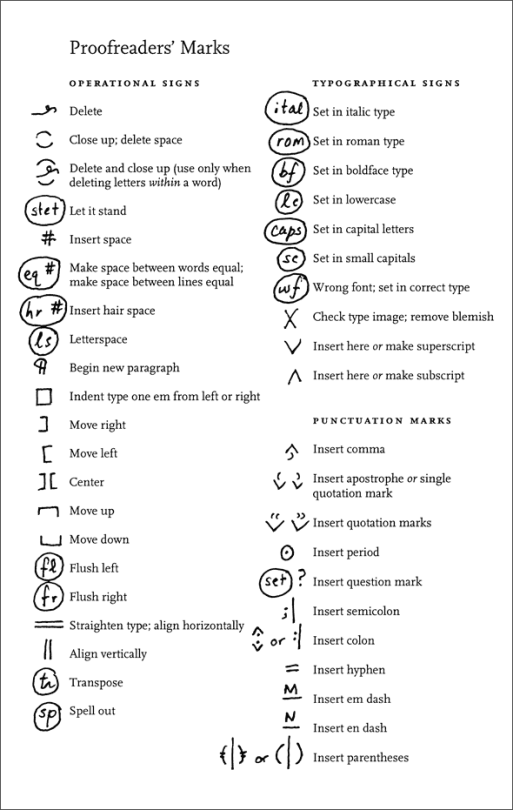
When proofreading and marking up your manuscript, it can save a lot of time and energy if you use marks instead of actually write out everything, so here is a little chart I found that may be useful to you:
Other Things To Look Out For
Make sure you know who is talking
Keep tense consistent
Vary the tone from scene to scene
Run-on sentences
Inconsistencies in story details
Plot holes
Causes and effects of events are explained
Facts and technical details {Make sure you’ve researched them well}
Deviations from established background (know your story really really well and make sure your reader does too)
General Tips
Go in assuming that your work is full of errors. Maybe it’s not, but it’s better to be prepared for the worst and solve the issues now rather than when it’s too late
DO NOT BE SENTIMENTAL. Yes, easier said than done, but it’s possible.
Make the text less recognizable to yourself in order to catch details you may not otherwise.
Print out your manuscript and physically write out the changes.
Read your writing out loud. Sometimes writing looks like it makes sense, but in reality sounds wrong.
Do it in short periods over time so that you don’t inevitably get lazy with paying attention to little details
Keep in mind that editing usually takes longer than actually writing the draft because it is less fluid and requires more thought and problem solving.
Don’t rely on spelling and/or grammar checking software; they’re not always correct and can easily misinterpret what you’re trying to get across.
Check for a single error at a time. It may be time consuming and tedious but it’s more effective than the alternative.
Give yourself time and read slowly through it multiple times
Split up large chunks of text to make it easier to handle. Don’t go through your whole manuscript page by page as if you were just reading it as a book. Go chapter by chapter or scene by scene or even sentence by sentence.
If something seems off, investigate it. Don’t take a chance and leave it be. If you’re stumped, highlight it and have someone else look over it.
Have a strategy. Maybe not at first, especially if you don’t extensively edit your work regularly, but with time you’ll find what works for you and what doesn’t. Create your own system and use it to save yourself some time and confusion.


 Mostly reblogs and random words